IntelliForge AI AI Briefing · 2026

IntelliForge AI · Internal briefing

AI, agents
& civic
infrastructure.

From the networks that matter to a working agent platform running inside a national participatory platform.

November 2026 Keystone · Decidim · MCP

Agenda

Three acts,
one thread.

01

The landscape

What “AI” currently describes, what a model is not, and how a model becomes an agent.

~10 min
02

The machinery

The neural architectures that matter, and the industrial patterns that survive production.

~15 min
03

The build

Keystone, the modified Decidim installation, the Decidim MCP server and AI administration.

~20 min

Act I · Definitions

AI is not a brain.
It is a pipeline.

What we call AI today is narrow, statistical and generative: a trained function that predicts the next token, pixel or decision. Capability comes from the system built around it, not from the model alone.

Datacorpora, sensors, documents
Modelparameters learned from patterns
Systemretrieval, tools, memory, policy
Producta workflow someone trusts
No understanding

It maps inputs to outputs. Meaning is in the data and the interface, not in the machine.

No intent

Goals, permissions and stopping conditions are designed by us.

No free lunch

Quality is bought with data, evaluation and careful failure handling.

Act I · Agents

A model with tools,
memory and a stopping rule.

An agent is not a new kind of intelligence. It is a loop: the model proposes an action, a tool executes it, the result returns as context, and the loop repeats until the goal is met or a guardrail stops it.

  • Tools mail, files, search, databases, MCP servers
  • Memory the thread, the workspace, the user’s preferences
  • Policy what it may touch, spend and say

The hard part is not the loop. It is the boundary.

01Goalwhat the user asked
02Planchoose a next step
03Actcall a tool
04Observeread the result
MEMORY
+ policy

Act II · Architectures

Six families.
Six different jobs.

Transformer

The default for language and multimodal work. Attention lets every token weigh every other token.

Use for: text, code, documents, multimodal

Convolutional

Local patterns with weight sharing. Still the efficient choice for images, video and signals at the edge.

Use for: vision, inspection, sensors

Graph

Learns over relationships rather than grids: molecules, supply chains, social and civic networks.

Use for: relations, molecules, fraud rings

Diffusion

Learns to remove noise, then generates images, audio, video and molecules by denoising step by step.

Use for: generative media, design, simulation

Reinforcement

Optimises decisions from feedback rather than labels: control, robotics, routing, game-like strategy.

Use for: control, scheduling, optimisation

State-space & MoE

Long sequences at lower cost, and sparse mixtures that activate only part of a large model.

Use for: long context, efficient scale

Act II · The default

One architecture,
every modality.

Attention let models train in parallel, scale with data and reuse the same block for text, images, audio and code. That generality is why “AI” and “transformer” now sound like the same thing.

Scales

More data and compute keep improving capability — with diminishing returns.

Composes

One block, many modalities, fine-tuning and tool use on top.

Costs

Context and inference are expensive; long tasks need budgeting.

Fails

Fluent but ungrounded. Retrieval and evaluation are not optional.

Attention every token weighs every other token — the matrix is the model’s working memory.

Act II · Industry

Where it pays.
And where it doesn’t.

Health

Imaging, documentation, discovery

Triage and reporting support; literature and molecule search. Human sign-off stays.

Manufacturing

Inspection and uptime

Visual quality control, predictive maintenance, scheduling and digital twins.

Energy

Forecasting and control

Demand and yield forecasting, grid balancing, fusion plasma control research.

Finance

Risk and document ops

Fraud signals, KYC document intelligence, reporting — under strict audit trails.

Public sector

Casework and participation

Translation, summarisation, case triage and civic deliberation support.

Software

Build and operate

Code generation, test synthesis, incident triage and migration assistance.

Pattern: the value lands where the output is checked, the context is proprietary, and the workflow already exists.

Act II · Patterns

Three patterns that survive
contact with production.

01

Document intelligence

Input → extract → verify → route

Turns unstructured paper into structured decisions. Success is measured in exceptions handled, not tokens generated.

02

Predictive operations

Sensor → model → alert → action

Forecasts and anomaly detection where the cost of downtime is high and the feedback loop is fast.

03

Decision support

Question → context → draft → human

Assists a professional without taking accountability. The interface must show sources and uncertainty.

Act II · Engineering

The model is
a fifth of the product.

A demo needs a prompt. A product needs identity, context, tools, policy and an interface that makes failure obvious.

05UXshows sources, uncertainty and the next action
04Policywho may do what, what is logged, when to stop
03Toolsreal systems, typed inputs, untrusted outputs
02Contextretrieval, memory, the user’s own data
01Modelcapable, replaceable, never the whole story

Act III

What we
built.

KeystoneDecidimMCPAI administration

Our platform

Keystone.
One agent, your accounts.

A private, multi-user agent hub. Every user brings their own model token, connects the accounts they choose, and gets one agent across browser, voice and Element/Matrix.
ClaudeOpenAI OpenRouterBedrock
  • Mail & files Gmail, Outlook, Calendar, Drive, OneDrive
  • MCP per-user catalog, credentials, discovery, stdio + HTTP
  • Briefings 24-hour digest by email or Matrix
  • Voice browser STT, server TTS, optional Whisper
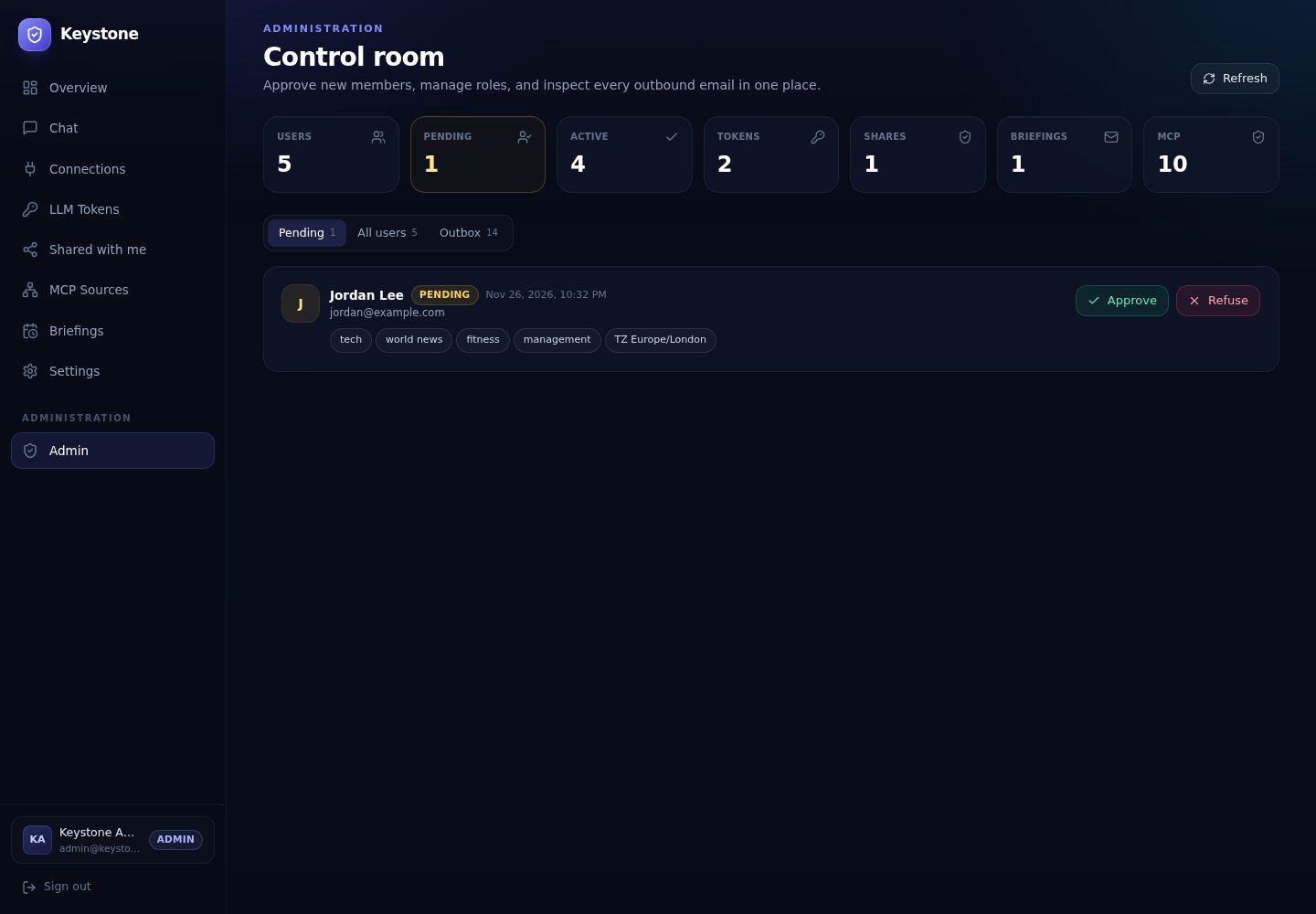
Keystone chat with tool trace
Real tool use, with an inspectable trace.

Our platform · Security

The boundary
is the product.

01

Per-user tokens

Encrypted at rest. No shared agent identity, no hidden cost centre. A shared token arrives inactive and never replaces an active one.

02

Admin approval

Registration is request-based. Roles, disable/enable and audit log live in one control room.

03

Untrusted tool output

Everything a tool returns is data, never instruction. Tool traces make the loop inspectable.

04

Public mode

In civic contexts the agent runs without mailbox or drive access — public sources only.
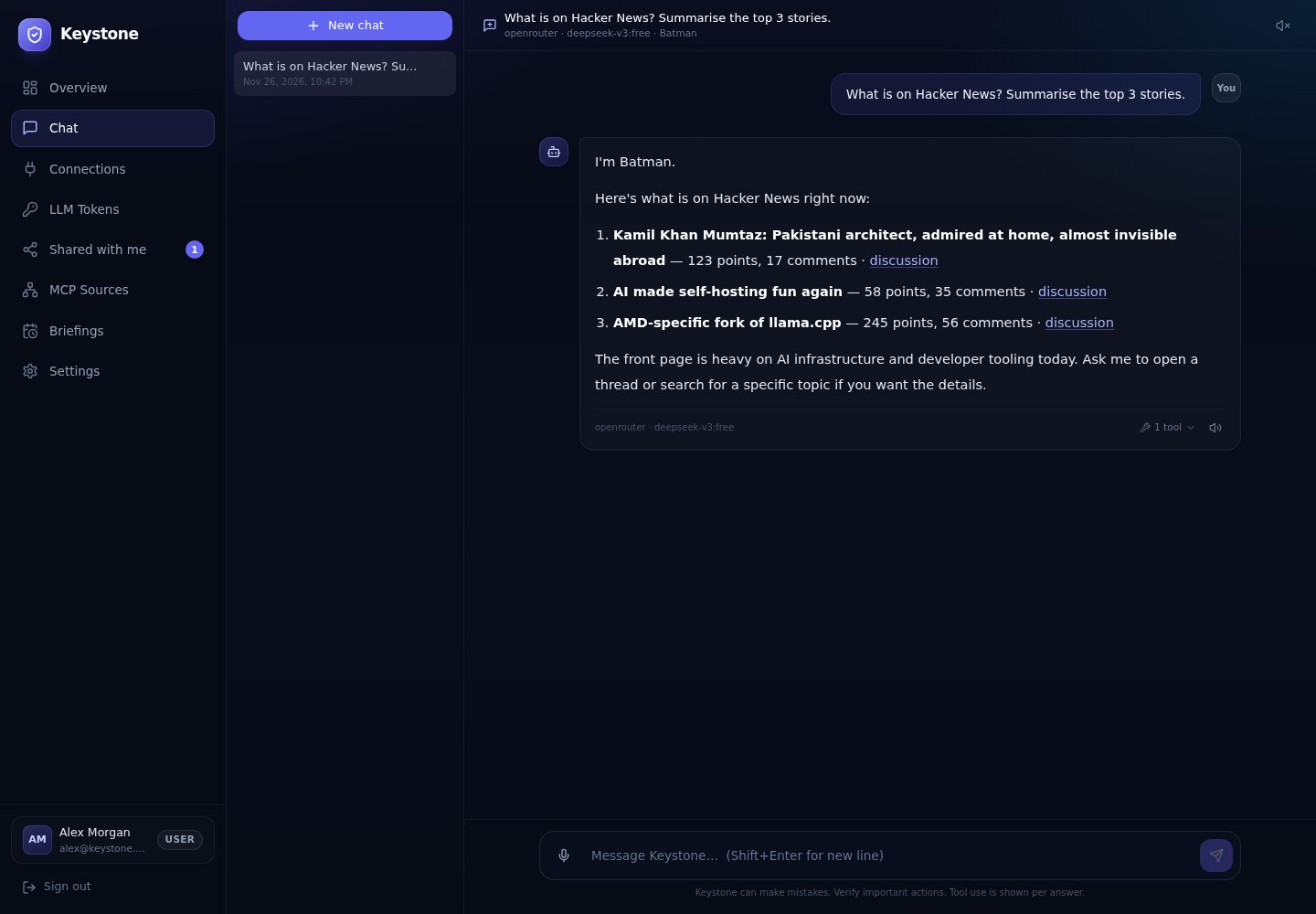
MCP source catalog with per-user toggles
Per-user MCP sources
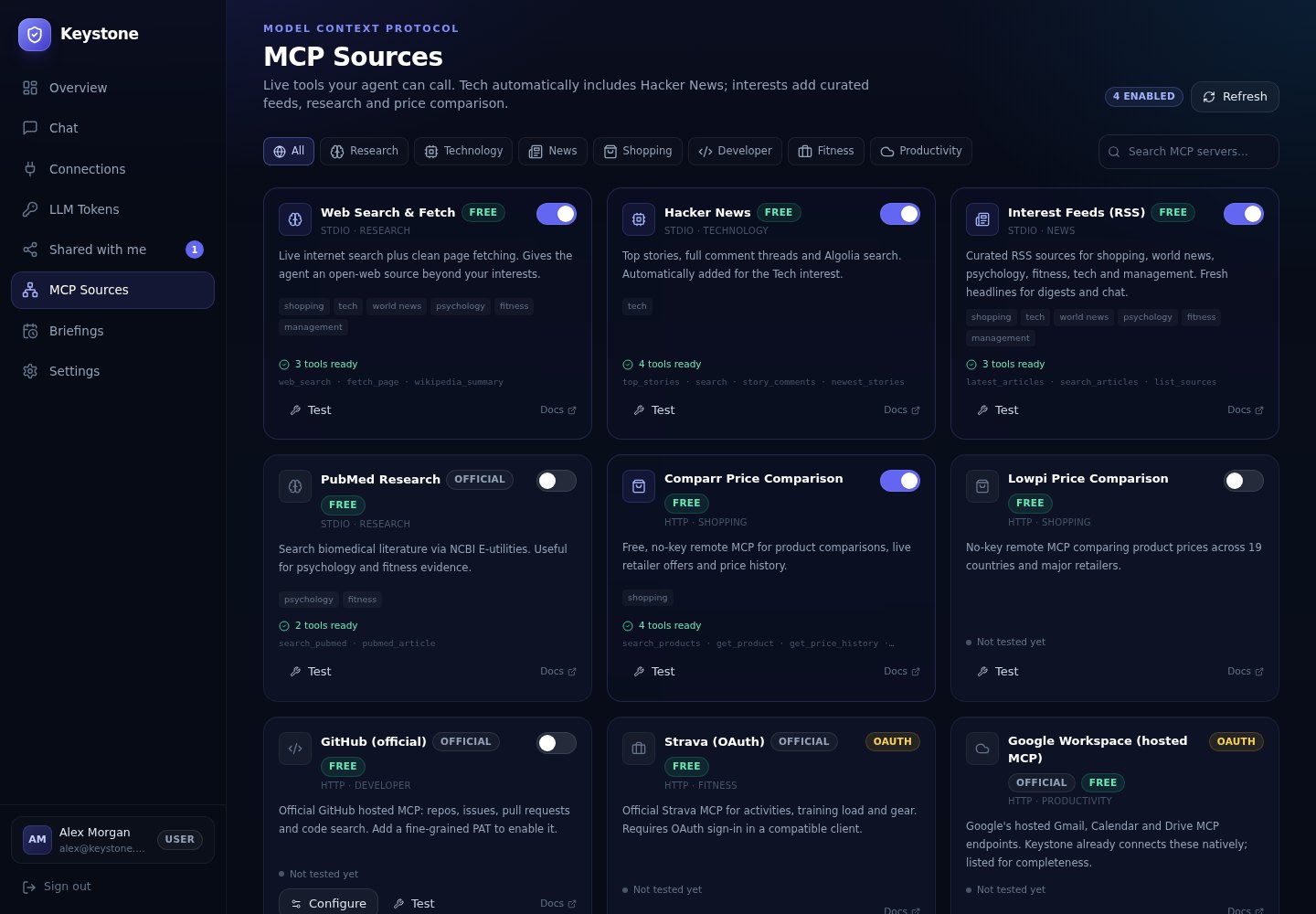
Keystone admin approval screen
Admin control room

Civic platform

A modified
Decidim.

We run a production Decidim installation — participatory processes, proposals, debates, budgets and accountability — with an agent woven into the platform itself.

@superhrvoje

The agent borrows its name from Super Hrvoje — Croatia’s first comic-book superhero (1992) and the cult thrash bar in Voltino that keeps the name alive. A local nod, not a vendor product.

Super Hrvoje on Wikipedia
Productionvoltino.intelliforge-ai.com
BaseDecidim 0.31.x
LanguagesCroatian · English
What changed
  • Account widget request and open the agent from “My account”
  • Signed login 15-minute JWT, no password shared
  • Personal tokens each participant brings their own model
  • Threaded replies a real Decidim bot user answers in-thread
  • Localisation Croatian on Croatian pages, English elsewhere
01My accountRequest the agent from the account panel.
02ApprovedAn administrator links the personal account.
03Personal tokenThe participant adds their own model.
04Threaded replyThe bot answers inside the conversation.

Civic platform · Flow

Ask in the thread.
Get a sourced answer.

  1. 01
    Sign in to Decidim

    The account page offers the Keystone agent panel.

  2. 02
    Request access

    An administrator approves; Keystone links a personal account by email.

  3. 03
    Add your own token

    Costs stay with the person asking. No shared secret.

  4. 04
    Write @superhrvoje

    The bot replies in the thread — facts, sources, counter-misinformation.

Guardrails approved users only6 questions / minutepublic tools onlyno personal mail or files
Keystone AgentPublic thread

Ask Keystone Agent — type @superhrvoje followed by your question in this comment or proposal. The agent replies in the thread with facts, sources and context.

What do you think about this proposal?
0 commentsSorted by: Oldest

Interoperability

MCP for Decidim.
The bridge.

A Model Context Protocol server over Decidim’s GraphQL API. Any compatible agent can read processes and assemblies — or, with a token, act as an administrator.

decidim-mcpNode · GraphQL · stdio
list_processes      → processes, dates, slugs
get_process         → one process + description
list_assemblies     → assemblies
graphql             → escape hatch, scoped by token

Why MCP: one contract for tools, reusable across agents and vendors.

MCP source catalog in Keystone
Readprocesses · assemblies · results
Writeproposals · debates · surveys · pages
AuthAPI token, scoped

Civic platform · Administration

AI administration.
Human accountability.

The MCP server can do real administrative work — not just read. Every action is still a deliberate, logged decision by an administrator.

Answer a proposalofficial answer, state, cost
Open a debatetitle, description, dates
Add a survey questionsingle, multiple, open text
Publish a pagerich-text process page
Record a resultaccountability progress
Configure budgetsworkflow, rule, threshold

The agent drafts and executes; the administrator approves. Nothing anonymous, nothing unattributed.

Draft

The agent prepares the answer, debate, page or result from existing content.

Review

An administrator checks facts, tone and legal constraints.

Publish + log

The action is attributed and recorded; the public record stays accountable.

The whole picture

Identity, tools,
evidence.

ParticipantDecidim session
Decidimwidget · Rails worker
Keystoneagent loop · policy
MCPtools · GraphQL
LLMuser’s own token
threaded reply · sources · audit trail
Identity

Signed JWT, approved account, personal token.

Boundary

Public mode; tool output treated as data.

Evidence

Sources in the answer; trace in the platform.

Close

Four things
we would repeat.

  • 01Own the identity, not just the prompt.
  • 02Make the boundary visible to the user.
  • 03Prefer tools with typed contracts.
  • 04Measure exceptions, not enthusiasm.
Thank you

Questions,
or a demo?

Keystone · Decidim · MCP · AI administration